
Rocks, OKRs, or Something Else? What Actually Makes Goal-Setting Work
Every quarter, leadership teams across thousands of growing companies sit down to do the same thing: set goals. The challenge isn't usually ambition or a lack of strategic vision – it's what happens in the weeks that follow, when those goals get buried under the noise of day-to-day operations, fire-fighting takes precedence, and nobody can quite remember who owned what.
Two frameworks dominate the conversation around fixing this: Rocks, a cornerstone of the Entrepreneurial Operating System (EOS), and OKRs (Objectives and Key Results). If you've spent time in the startup or growth-stage world, you've probably encountered at least one of them.
Choosing the right framework can feel overwhelming when you're already stretched thin, and honestly, there's no universally right answer. What matters more is whether your team will use it consistently, whether everyone understands it, and whether it creates real accountability rather than just a well-formatted spreadsheet.
Let's break down what each framework actually is, where each one shines, and how to ensure your goals become actions regardless of which framework you select.
What Are Rocks?
Rocks are a goal-setting tool that sits within EOS, the Entrepreneurial Operating System developed by Gino Wickman and detailed in his book Traction. The name Rocks comes from a prioritization metaphor originally attributed to Stephen Covey: if you fill a jar with sand and pebbles (day-to-day work and life beyond) before you add the rocks (strategic priorities), the rocks won't fit. Your Rocks have to go in first for everything else to work around them.
What this looks like in practice is that every quarter the leadership team identifies 3–7 company-level Rocks together. These typically filter down from annual and long-term plans and represent the most critical priorities for the next 90 days. Rocks are things that, if completed, will meaningfully move the business forward. Each Rock has a single owner and a 90-day deadline. Departments and individual team members may also set their own Rocks that cascade from the company priorities, though their impact is more localized.
What makes Rocks distinct isn't the goal-setting itself, it's the ecosystem around it. Rocks live inside a full operating rhythm that includes a weekly meeting agenda, a scorecard for tracking health metrics, an accountability chart that defines who owns what, and a quarterly planning cadence. The framework isn't just about setting priorities; it's about building the habits to execute them.
This is both its greatest strength and its most significant commitment. EOS is a system. You're not just adopting a goal format — you're adopting a way of running your business. That said, you don't necessarily have to go all-in to get value from it. The core ethos is straightforward: set your biggest priorities, communicate them clearly, check in regularly so they don't get sidelined by the day-to-day, and hold each owner accountable for their outcomes. Many teams start by adopting just Rocks & Issues before layering in other components like People & Data.
What Are OKRs?
OKRs were developed by Andy Grove at Intel and later popularized by John Doerr, who introduced them to Google in the company's early days. The format is deceptively simple:
Objective: What are we trying to achieve? (Qualitative, inspiring, directional)
Key Results: How will we know we got there? (Quantitative, measurable, time-bound)
A single objective typically has 2–4 key results attached to it.
OKRs are usually set quarterly, though some organizations adapt the cadence to their pace — faster-moving startups sometimes run monthly OKRs, while larger or slower-moving organizations may extend them to six-month or annual cycles.
One of OKRs' distinguishing features is the concept of stretch goals. OKRs are often intentionally ambitious — hitting 70% of an OKR is considered a success, not a failure. This creates a culture of reaching rather than sandbagging. It also means OKRs require a certain level of psychological safety to work well. Teams need to feel comfortable setting bold targets without fear of being penalized for falling short.
Transparency is typically a key part of the OKR model with everyone’s objectives and key results visible to the organization. The idea is that when people can see what others are working toward, alignment happens more naturally and duplication gets caught early. The system is also designed to cascade – with company level objectives informing team-level OKRS, which in turn shape individual ones. Unlike EOS however, there is more emphasis on blending top-down and bottom-up goal setting. This can create stronger individual ownership if working well, however it has potential to cause teams to pull in different directions.
Unlike EOS, OKRs are a standalone goal framework. They don't come bundled with a meeting structure, an accountability system, or a people management approach. That flexibility works well for organizations with a strong operational foundation who just need a goal layer, not a new way of working.
How Are They Similar?
Both frameworks are built on many of the same foundational premises:
You can’t do everything, so you need to deliberately decide what matters most
Both tend to use quarterly timeframes as a primary rhythm, although this is much more rigid when adopting EOS
Both require clear ownership. A goal without a name attached to it is not really a goal
Both assume that leadership teams will review progress regularly and discuss progress and blockers, not just at the start and end of each quarter
The overlap is significant enough that the real differences between them are less about philosophy and more about how much structure, or rigidity, comes bundled in. Some teams even use a hybrid approach, attaching key results to their Rocks upfront in order to define what it means when a rock is done.
Where They Diverge
The meaningful differences come down to scope and structure.
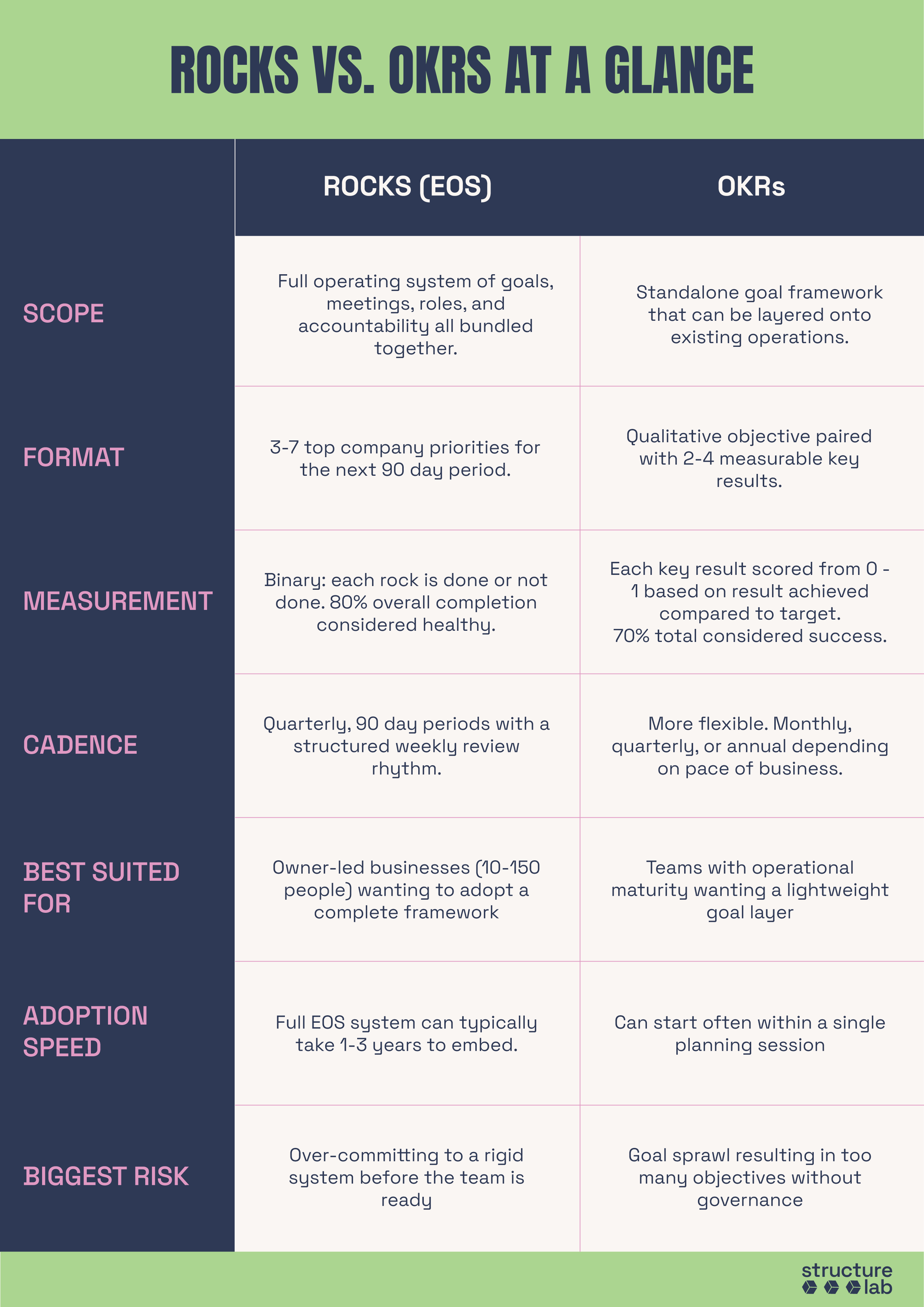
EOS is an operating system. OKRs are a goal tool.
EOS wraps goal-setting inside a complete framework for running a business. It helps define how you hire, how you meet, how you resolve issues, and how you define roles. Rocks are one component of six within EOS. If you implement EOS fully, your Rocks don't exist in isolation; they're connected to the other elements of your operations. EOS tends to suit owner-led businesses with 10–150 people that want a complete operating framework, not just a goal layer.
OKRs, by contrast, don't prescribe anything outside of goal-setting. They're portable and can be layered onto whatever operating model you already have. That's their power — and their limitation. OKRs won't fix your meeting culture, clarify your organizational structure, or tell you how to resolve issues. They assume those things are already working. They tend to suit teams that already have operational maturity and want flexibility in how goals are structured across departments.
Rocks enforce constraint. OKRs can drift toward abundance.
The 3–7 Rock limit isn’t just an arbitrary number. It forces hard conversations about what actually matters this quarter and ensures that the business carves out time to focus and work solely on those strategic objectives.
In practice, teams using OKRs without clear governance can end up with dozens of objectives across departments, each cascading into multiple key results — a planning exercise that starts to feel more like a spreadsheet audit than a leadership conversation. The framework itself doesn't stop this from happening.EOS requires more upfront commitment. OKRs are faster to adopt.
A full EOS implementation typically takes one to three years to embed properly. Rocks alone can be introduced faster, but many teams do find they work best within the broader system. OKRs can often be started in a single planning session. For teams that need quick wins or are resistant to wholesale change, OKRs offer a lower barrier to entry.
Where Do KPIs Fit?
It’s worth briefly clarifying what KPIs are and where they play a part with goal-setting frameworks. These can often be conflated and cause confusion in the business.
KPIs measure the health of your business. They're the ongoing metrics that tell you whether operations are stable and functioning as expected and are often a mix of leading and lagging indicators. Movement in a KPI would indicate an issue that needs addressing or a planned effect from an initiative. These serve as your pulse check on the business.
Rocks and OKRs are change vehicles. They represent what you're intentionally moving, building, or improving this quarter. The work that pushes the business forward, not just keeps it running.
A clean way to think about it: KPIs measure the business. Rocks and OKRs move it.
Both frameworks rely on having good KPIs underneath them. Getting clear on what your business measures consistently and what your targets are is often necessary to begin setting goals.
What Actually Makes Goal-Setting Work
Whichever system you choose, or whichever pieces you borrow, the businesses that actually get results from their goal-setting is more about the habits they embed than the system they use. The framework is just scaffolding. These are the load-bearing walls that make your team effective:
Keep the list short and give every goal a name.
Three to five priorities that actually mean something will always outperform a list of fifteen that nobody remembers. Err on the side of less is more. And every goal needs a single owner — not a team, not a department, a person. If no one's name is on it, no one's accountable for it.
Define what done looks like before you start.
One of the most common failures, especially with Rocks, is that teams set goals assuming everyone shares the same definition of success. They don't. Attach measurable outcomes upfront so there's no debate at the end of the quarter about whether something was actually completed.
Build a rhythm of checking in, not just setting and forgetting.
Weekly progress reviews, even brief ones, keep priorities visible when day-to-day fires are competing for attention. The quarterly plan only works if the weekly habits support it.
Get buy-in, not just alignment.
Setting goals behind closed doors and handing them down doesn't build ownership. Make time at the start of each quarter for your team to discuss, pressure-test, and commit to the priorities together. People execute differently when they've had a hand in shaping what matters. Dependencies and capacity constraints almost always surface in these conversations and it’s better to catch them early than at quarter-end.
Speak the same language.
It sounds minor, but terminology matters more than people think. If different parts of your organization use different names for the same thing, people lose the ability to tell what actually matters and what should take priority. Pick your terms, define them clearly, and use them consistently across meetings, dashboards, and updates.
Be careful tying goals to compensation.
It’s a natural instinct to hold people accountable by linking their priorities to their pay, but in practice this can often backfire. Teams stop setting ambitious targets, individuals hide problems instead of raising them, and reprioritization starts feeling like personal failure. Both frameworks are designed with some built-in grace – EOS considers 80% Rock completion healthy and OKRs treat 70% as a strong score. The flexibility only works if people aren’t afraid of the consequences, keeping your goal reviews and performance reviews as separate conversations protects that.
You don't need to adopt any system in its entirety.
There’s a tendency to treat frameworks as all-or-nothing, as if using Rocks without the full EOS implementation means you’re doing it wrong or as if there’s only one correct way to run OKRs. In practice, the businesses that get the most out of these frameworks are the ones willing to adapt them. Take the pieces that solve real problems for your team right now. Add more structure as you grow into it.
The point isn't which acronym you put on your quarterly plan. It's whether your team knows what matters, who owns it, how you'll measure progress, and what happens when things go off track. Get those right, and the framework takes care of itself.
If you’re not sure where to start, I help growing teams build the operational structure and habits that make goal-setting actually stick. Reach out if you want to talk it through.
